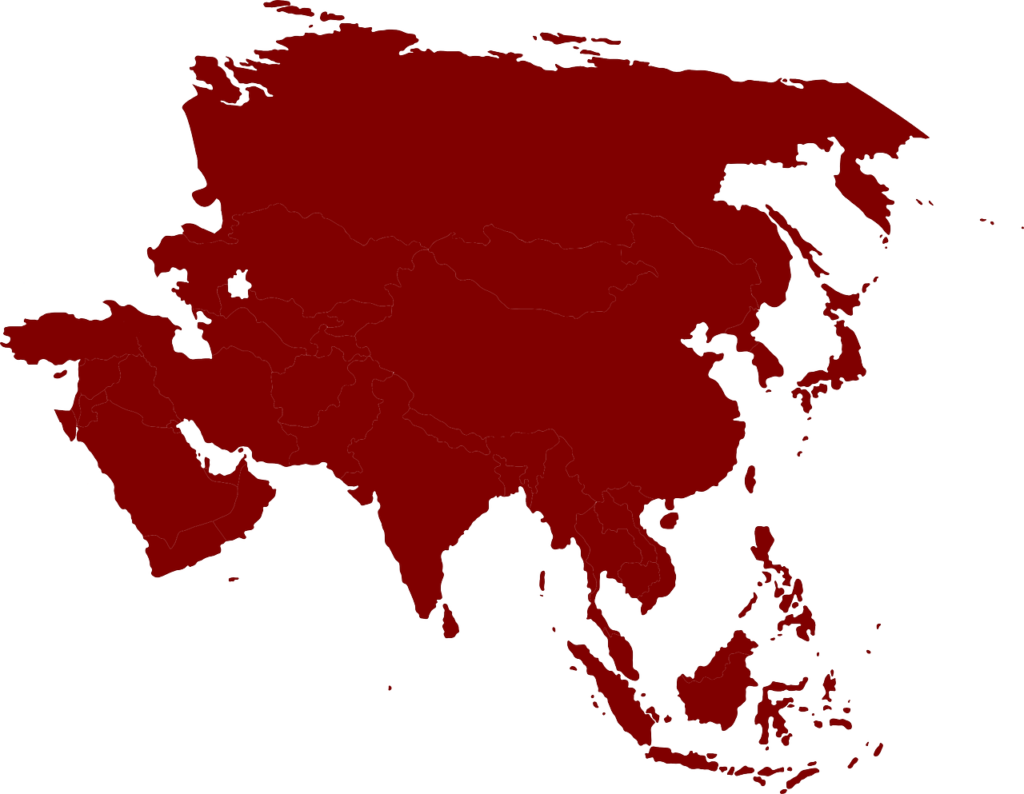
Asia
Interesting Information
History & Culture
Asia is the largest and most populous continent, and it has been home to some of the world’s oldest civilizations. Ancient cultures such as Mesopotamia, the Indus Valley, and early China laid the foundations for writing, mathematics, agriculture, and governance. Great empires like Persia, Mongolia, India’s Maurya and Gupta, and China’s Han and Tang dynasties shaped trade, politics, and culture for centuries. The Silk Road connected Asia to Europe and Africa, spreading goods, religions, and ideas across continents.
In the modern era, Asia experienced colonization, conflict, and rapid transformation. Many countries won independence in the 19th and 20th centuries, while others became global powers in technology, industry, and finance. Today, Asia is a continent of contrasts: ancient traditions exist alongside booming megacities, and cultural diversity remains one of its most defining features.
Population & Language
Asia has more than 4.7 billion people, making it home to over half of the world’s population. China and India are the two most populous countries, each with more than a billion residents. The continent is highly urbanized, with some of the world’s largest cities, yet vast rural areas remain central to life.
Asia’s linguistic diversity is immense. Major languages include Mandarin, Hindi, Arabic, Japanese, Korean, and Russian, alongside hundreds of regional languages such as Thai, Persian, and Tagalog. Indigenous languages remain important in many regions. Religions such as Hinduism, Buddhism, Judaism, Christianity, and Islam all began in Asia, making it the birthplace of many of the world’s spiritual traditions.
Geography & Climate
Asia covers about 17 million square miles, stretching from the Middle East to the Pacific Ocean and from the Arctic tundra to the tropics. It features towering mountain ranges like the Himalayas, deserts such as the Gobi and Arabian, vast river systems like the Yangtze and Ganges, and fertile plains that support agriculture for billions.
The climate is as diverse as the geography. Northern Asia experiences freezing Arctic winters, while Southeast Asia is tropical and humid. The Middle East is dominated by arid desert climates, while monsoon rains shape much of South and East Asia. This variety of landscapes and climates has influenced settlement, culture, and economic activity for thousands of years.
Top Tourist Destinations
Great Wall of China, China
Taj Mahal, India
Angkor Wat, Cambodia
Mount Fuji, Japan
Petra, Jordan
The Maldives
Bangkok, Thailand
Dubai, United Arab Emirates
Bali, Indonesia
Mount Everest, Nepal/Tibet
Most Populated Cities
Shanghai, China
Beijing, China
Karachi, Pakistan
Guangzhou, China
Mumbai, India
Shenzhen, China
Delhi, India
Istanbul, Turkey
Dhaka, Bangladesh
Tokyo, Japan
Where do you want to go?
East Asia

South and Central Asia

The Middle East

Southeast Asia
Where is it?